

Share


In industrial projects, ensuring design accuracy, coordination efficiency, and smooth implementation from the early stage is critical. However, with increasingly complex systems involving multiple disciplines, relying solely on 2D drawings can make it difficult to visualize the overall plan and identify potential issues in advance.
By combining Building Information Modeling (BIM) with advanced simulation technologies, Taikisha Vietnam enables clients to clearly visualize facility layouts, validate system performance, and make informed decisions from the planning stage.
This integrated approach helps deliver facility plans that are easy to understand, reliable, and highly efficient.
Delivering High-Quality Solutions with 3D Models
Taikisha Vietnam offers high-quality solutions that utilize 3D models, from the design stage to construction and operation.
① Facility Design Using BIM
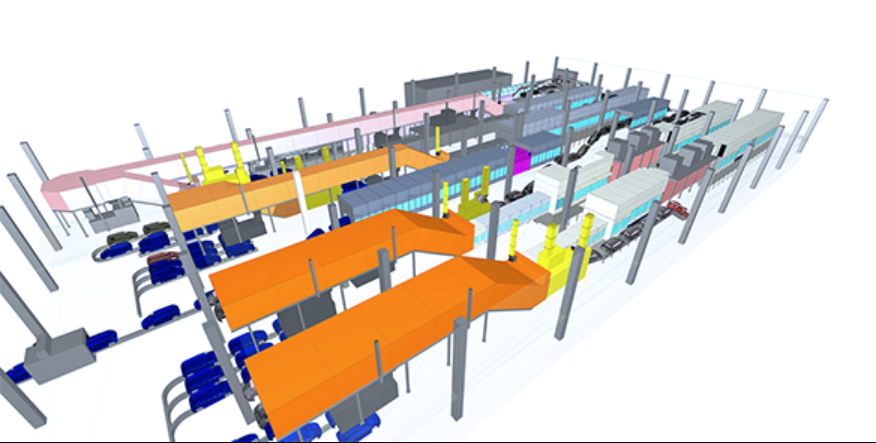
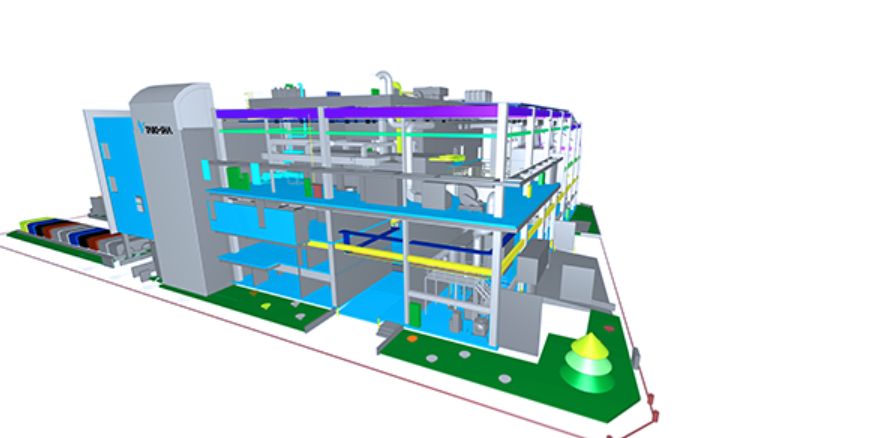
Taikisha integrates buildings, equipment, piping, and transportation systems using BIM, making facility plans fully visible in three dimensions.
BIM allows us to check layout, fit, interference points, as well as construction and maintenance space in advance — enabling highly accurate proposals from the planning stage.
Even in meetings with customers, complex equipment configurations that are difficult to convey through conventional drawings can be easily shared, supporting smooth communication and faster consensus building.
As a result, we provide reliable and efficient facility plans that help reduce rework and improve project execution.
② Validating Production Lines Using 3D Models
3D models are also used to verify production lines.
By simulating robot operating ranges, transport flow, workspace, and production takt time, the movement and efficiency of the entire line can be clearly understood before actual implementation.
This enables:
As a result, we can propose lean and efficient line configurations that enhance productivity.
Preliminary verification using 3D models directly contributes to building more reliable and competitive production lines.