

Share


As industries place greater emphasis on environmental protection and energy efficiency, effective exhaust gas treatment has become increasingly important in production facilities.
Taikisha Vietnam provides engineering solutions that support customers in addressing environmental challenges in industrial operations. Among these technologies, RTO (Regenerative Thermal Oxidizer) is designed to remove volatile organic compounds (VOCs) from exhaust gases while recovering and reusing heat to improve energy efficiency.
What is VOC Removal Technology?
We offer a wide variety of environmental protection equipment, ranging from various exhaust gas treatment systems and dust collectors to wastewater treatment systems.
This section introduces an exhaust gas treatment system designed to treat organic gases generated from various industrial plants.
What are Post-Processing Units?
Solutions for These Challenges
Overview
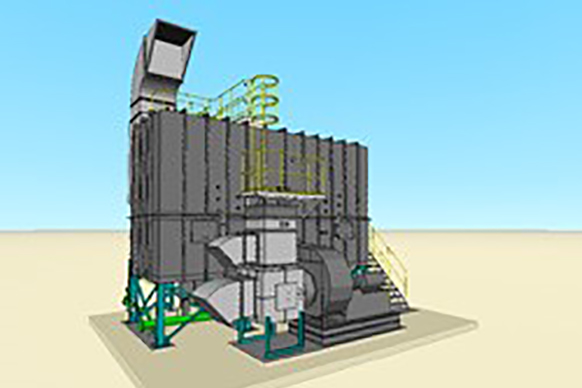
RTO is an energy-saving system that oxidizes and decomposes VOCs (Volatile Organic Compounds) at 850°C or higher.
It is suitable for the treatment of high-concentration gases and for use as a post-treatment unit for Admat.
Features
1. Durable and Thermally Efficient Deodorization System with Ceramic Heat Storage Material
A ceramic medium is packed as a heat storage material in the heat exchanger.
The ceramic material provides high durability, high thermal efficiency and low pressure loss.
Thermal efficiency can be adjusted from 85% to 95%, helping minimize energy consumption and requiring little supplemental fuel, thereby contributing to greater energy savings.
When the target exhaust gas has a high concentration, a waste heat boiler can be installed to recover heat in the form of steam and hot air as a heat medium.
2. Sustained Treatment Efficiency of 98% or Higher for Exhaust Gas
RTO’s standard heat exchanger consists of two towers, with heat storage material packed in each.
The target gas passes through the heat storage material in one tower and is heated to approximately 750°C. It then enters the reaction chamber in the upper part of the tower, where the gas is heated to 800°C or higher by a burner so that the organic solvents contained in the gas are oxidized and decomposed.
The cleaned hot air then flows into the other tower, moving downward while releasing heat into the heat storage material.
The damper at the intake repeatedly switches the operation between heat storage and heat release within the two towers.
With its stable operation and treatment efficiency of 98% or higher, the RTO system is highly effective as an environmental measure for exhaust gas treatment.
3. Applicable to Environmental Measures for Exhaust Gases in Safety Assessment Testing
RTO has also been applied to total treatment systems that include both exhaust gas treatment and water treatment.